
Lu, Y., Li, J., Yi, K., & Jia, X. (2026). Programmable plant nutrition through synthetic transportome engineering. Journal of Plant Physiology, 326, 154874. https://doi.org/10.1016/j.jplph.2026.154874
Title: Programmable plant nutrition through synthetic transportome engineering
Authors: Yao Lu, Jia Li, Keke Yi, Xianqing Jia
Abstract: Plant nutrient homeostasis emerges from the coordinated transport, partitioning, and storage of nutrients across cellular compartments, tissues, and developmental stages. These processes form an interconnected transport system in which local changes in nutrient uptake, redistribution, or sequestration can propagate across biological scales and ultimately shape whole-plant nutrient status and growth. This system-level organization suggests that nutrient homeostasis should be viewed not simply as the output of individual transporters, but as an emergent property of a coordinated transport network. Here, we propose the synthetic transportome as a transportcentered, systems-level framework for rationally designing native and/or engineered transport components, regulatory circuits, and spatial architectures to achieve predefined nutrient flux and allocation states. Unlike descriptive systems-level analyses, this framework treats nutrient engineering as an inverse-design problem, in which desired nutrient fluxes and physiological outputs guide the selection and coordination of transport modules. We further propose design principles and enabling technologies, integrating multi-omics, machine learning, structural biology, and synthetic biology. Synthetic transportome engineering provides a conceptual framework for quantitatively predictable and environmentally robust nutrient engineering, paving the way toward programmable nutrient utilization in crops.
News:
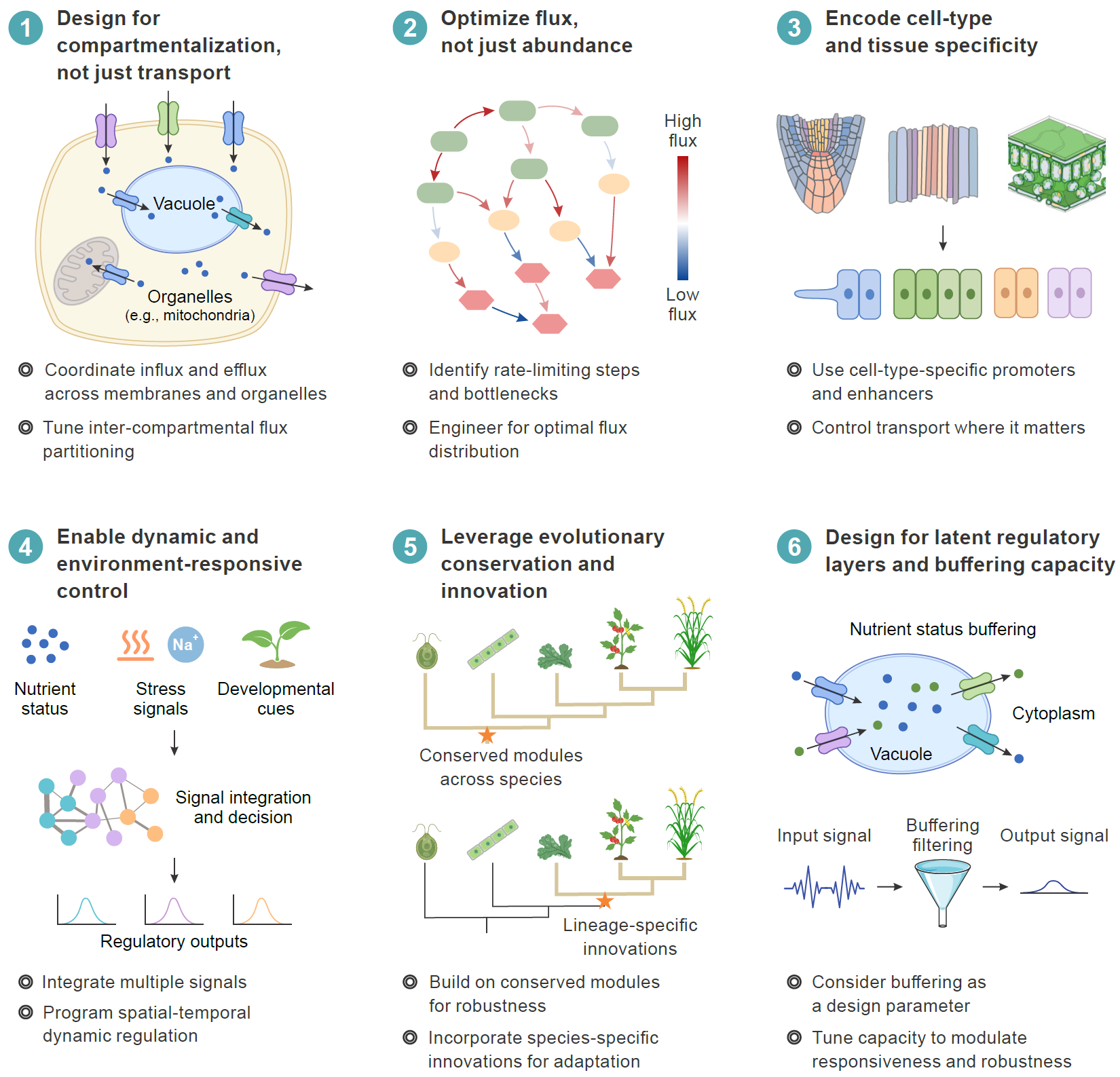
Design principles for plant synthetic transportome engineering
Core design principles governing transportome engineering. Nutrient phenotypes are shaped by compartmentalization, system-level flux constraints, spatial organization, dynamic regulation, evolutionary structure, and intracellular buffering. Together, these principles define a multidimensional design space in which nutrient fluxes emerge from coordinated transport processes.